

|

|

|

|

|

|

|

|
 Read Our Blog
 Find Us On Facebook
 Follow 2BSeeds On Twitter
Gourmet Sauces, Gluten and MSG-Free - Recipes - Gourmet made easy
Free Tomato Seeds for the Unemployed
Open Pollinated Vegetable Seeds
Vegetable Seeds
· Artichoke Seeds
· Asparagus Seeds
· Brussells Sprouts Seeds
· Bush Bean Seeds
· Bush Wax Bean Seeds
· Beet Seeds
· Broccoli Seeds
· Cabbage Seeds
· Carrot Seeds
· Cauliflower Seeds
· Celery Seeds
· Chard Seeds
· Cherry Tomato Seeds
· Chili Pepper Seeds
· Chinese Cabbage Seeds
· Collard Green Seeds
· Corn Seeds
· Cucumber Seeds
· Edamame Seeds
· Eggplant Seeds
· Endive Seeds
· Gourd Seeds
· Kale Seeds
· Kohlrabi Seeds
· Leeks Seeds
· Lettuce Seeds
· Luffa Seeds
· Melon Seeds
· Mizuna Seeds
· Mustard Green Seeds
· Okra Seeds
· Onion Seeds
· Pak Choy Seeds
· Pea Seeds
· Pepper Seeds
· Perilla Seeds
· Pole Bean Seeds
· Pumpkin Seeds
· Radish Seeds
· Rhubarb Seeds
· Spinach Seeds
· Strawberry Seeds
· Summer Squash Seeds
· Tomatillo Seeds
· Tomato Seeds
· Turnip Seeds
· Watercress Seeds
· Watermelon Seeds
· Winter Squash Seeds
Organic Vegetable Seeds
Container Patio Vegetable Seeds
Annual Flower Seeds
Perennial Flower Seeds
Herb Seeds
Flowers for Bees
Wildflower Seed Mixes
Fuseables Flower Seed Mixes
Seed Collections
Bee's Select Seeds
· Select Flower Seeds
· Select Herb Seeds
· Select Vegetable Seeds
Hummingbird and Butterfly Gardens
Customer Care
· 2B Seeds Home
· About Us
· Contact Us
· Become a Member
· Customer Testimonials
· Our Newsletter
· How to Order
· Check the Status of Your Order
· Zone Map
· Vegetable Seed Sowing Chart
· Starting Fall Crops
· Flower Seeds
· Shipping Info
· Security Policy
· Our Guarantee
· Download Order Form
· Seed Resources & Gardening Information
· 2B Seeds Press
· Sitemap
| Join Our Mailing List |


| You are here: 2B Seeds Home > Vegetable Seeds E-O > Kohlrabi Seeds > Winner F1 Kohlrabi Seeds |
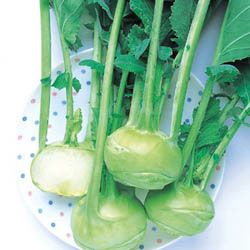
Winner F1 Kohlrabi SeedsThis unusual vegetable deserves to be grown and appreciated more. Kohlrabi is often described as a turnip growing on cabbage roots. The flavor is similar to both turnip and cabbage, but is milder and sweeter than either. 50 seeds per package. |
|
|
|
Vegetable Garden � Tips on Growing Kohlrabi From Seed
Very early variety, suitable for open field or protected environments, as well as for the home gardener. Has a flat globe shape with a mild, crisp white flesh that holds while staying tasty and crunchy.- Planting Depth: 1/4-1/2"
- Soil Temp. for Germ.: 60-65�F
- Days to Germ.: 8-12
- Average Spacing: 4-8 seeds/ft. in rows 24-36 in. apart.
- Days to Maturity: 60-65
- Light -Partial Shade/Full Sun
- Moderate Water
START INDOORS
- In a warm, well-lighted area about 4-6 weeks before planting outside.
- Sow seeds �" deep in seed starting formula. Keep evenly moist.
- Seedlings emerge in 8-12 days at 70� F. They will do best covered lightly with soil.
TRANSPLANT
- Seedlings can be placed outside 2-3 weeks before your last frost date. They grow best at 60� to 65� F.
- Be careful when transplanting, as their root system is very sensitive to shock.
- Set out Spring transplants about 4 weeks before the last frost so they mature in cool weather. Transplants just out of a greenhouse need initial protection from freezes.
- Set out Fall transplants about 6 weeks before the first frost. In fall, plants �hardened� by gradual exposure to cool weather are tolerant of frost. Kohlrabi that matures in cool weather is deliciously sweet.
- Give it fertile, well-drained, moist soil with plenty of rich organic matter.
- The key to a good kohlrabi is steady growth from the start. Avoid root-bound transplants.
- A soil pH between 6.5 and 6.8 discourages club root disease. To check pH, test the soil with a purchased kit, or get a soil test through your regional Cooperative Extension office. Fertilize and lime according to test recommendations.
- Without a soil test, add nitrogen-rich amendments such as blood meal, cottonseed meal, or composted manure to the soil. Or, you can work a timed-release vegetable food such as 14-14-14 into the soil according to label directions. Or a liquid starter fertilizer such as fish emulsion or Herb and Vegetable Plant Food at the of planting for a boost. Fertilize with a liquid fertilizer again after plants begin to develop new leaves and when they start forming heads.
- Kohlrabi needs at least 6 hours of full sun each day; more is better.
- Space about 12 inches apart. Exact spacing is not critical as long as you give the plants enough room to develop their swollen stems.
- Zone 1 -July 15th -June 15th
- Zone 2 -August 15th- May 15th
- Zone 3 -September 15th May 15th
- Zone 4 -September 15th May 15th
- Zone 5 -October 15th April 15th
- Zone 6 -October 15th April 15th
- Zone 7 -October 15th April 15th
- Zone 8 -November 15th March 15th
- Zone 9 -December 15th February 15th
- Zone 10 -December 15th January 31st (sometimes earlier)
- Zone 11 _No frost. No frost.
- Plant injury resulting from excessive soluble salts may first occur as a mild chlorosis of the foliage, later progressing to a necrosis of leaf tips and margins. This type of injury is largely attributed to the mobility of soluble salts within the plant. As these salts are rapidly translocated throughout the plant, they accumulate at the leaf tips and margins. Once the salts reach a toxic level they cause the characteristic "burn" associated with excessive salts. For an accurate reading get an EC meter.
- Soil pH is a measurement of the number of Hydrogen ions present in the soil solution along with as the acidity of the soil. When the soil pH is too acidic the nutrients that are present in the soil become locked-up or unavailable (low pH) or alkaline (high pH).
- Correcting the pH has the same effect as applying fertilizer as it unlocks plant nutrients already present. In your garden some garden plants thrive in acidic soils while others prefer an alkaline soil. The acidity or alkalinity of soil is a measurement by pH (potential Hydrogen ions). pH is a way to measure the amount of lime (calcium) contained in your soil, and the type of soil that you have.
- Add 4 ounces of hydrated lime per square yard in sandy soils
- Add 8 ounces of hydrated lime per square yard in loamy soils
- Add 12 ounces of hydrated lime per square yard in clay soils
- Add 25 ounces of hydrated lime per square yard in peaty soils
- The addition of ash, bone meal, or crushed oyster shells will also help to raise soil pH levels.
- Mix in 1.2 oz of ground rock sulfur per square yard if the soil is sandy
- Mix in 3.6 oz per square yard for all other soils.
- Composted leaves, wood chips, sawdust, leaf mold and peat moss, will also help to lower the soil pH.
USDA Hardiness Zone -First Frost Date- Last Frost Date
EC=Electrical Conductivity
To Measure Soil pH
It is recommended that you use a relatively inexpensive, and follow the manufacturers instructions when testing the pH Level of your Gardens soil. To raise or lower the pH level in the soil either Limestone or Sulfur is utilized. Other materials will accomplish the same results; however the two that are listed are the most commonly used.Limestone is added to the soil to raise the pH level because limestone is essentially calcium and calcium reacts with water in the soil to yield hydroxyl ions .. a process known as, hydrolysis = thus the pH level in the soil is raised.
Sulfur reacts with bacteria in the soil and produces sulfuric acid, which releases hydrogen ions thus causing the soil to become more acidic =the pH level is lowered.
Application Of Lime (To Raise Soil pH)
To increase your pH by 1.0 point and make your soil more alkaline.
Application of Sulfur (To Lower Soil pH)
If your soil needs to be more acidic, sulfur will lower the pH if it is available.
To reduce the soil pH by 1.0 point
Soil pH for Fruits and Vegetables
Most of all vegetables prefer a well-drained soil, rich in organic matter and slightly on the acidic side. A safe pH range for almost all vegetables is 6.0 to 6.5 pH. However � as always there are exceptions to the rule. To obtain optimal results a more precise tracking and maintenance of soil pH will be required. This is not as difficult as one people would assume it to be. The pH requirements listed below give the maximum and minimum range, so as long as you stay within these parameters your success will improve.
A soil with a pH lower than 7.0 is an acidic soil and one with a pH higher than 7.0 is alkaline.
This is an odd-looking member of the cabbage family, which is grown for its bulb-like stem that tastes like a mild, sweet turnip. You can also eat the leaves. High in fiber and vitamin C, it is a fast-growing, cool-season crop for both spring and fall. Plants are ready to harvest just a few weeks after planting. Kohlrabi needs an even supply of moisture to produce good bulbs. Mulch with compost, finely ground leaves, or finely ground bark to keep the soil cool and moist and to keep down weeds. Apply 1 to 1.5 inches of water per week if it does not rain. You can measure the amount of water with a rain gauge.Although the same pests that like cabbage can and will also attack kohlrabi, it is generally less troubled by aphids, root maggots, cabbageworms, and other caterpillars. Club root and black rot diseases in the soil can be a problem.
Harvest kohlrabi stems when they are still young and tender, usually about 2 inches in diameter. Harvest by cutting them from the base of the plant. You can trim the leaves from the stem and save them to cook separately. Kohlrabi keeps for 2 to 3 weeks in the fridge. You can peel and slice kohlrabi tubers to eat them raw with dips or in salad, or you can cook them like turnip.