

|

|

|

|

|

|

|

|
 Read Our Blog
 Find Us On Facebook
 Follow 2BSeeds On Twitter
Gourmet Sauces, Gluten and MSG-Free - Recipes - Gourmet made easy
Free Tomato Seeds for the Unemployed
Open Pollinated Vegetable Seeds
Vegetable Seeds
· Artichoke Seeds
· Asparagus Seeds
· Brussells Sprouts Seeds
· Bush Bean Seeds
· Bush Wax Bean Seeds
· Beet Seeds
· Broccoli Seeds
· Cabbage Seeds
· Carrot Seeds
· Cauliflower Seeds
· Celery Seeds
· Chard Seeds
· Cherry Tomato Seeds
· Chili Pepper Seeds
· Chinese Cabbage Seeds
· Collard Green Seeds
· Corn Seeds
· Cucumber Seeds
· Edamame Seeds
· Eggplant Seeds
· Endive Seeds
· Gourd Seeds
· Kale Seeds
· Kohlrabi Seeds
· Leeks Seeds
· Lettuce Seeds
· Luffa Seeds
· Melon Seeds
· Mizuna Seeds
· Mustard Green Seeds
· Okra Seeds
· Onion Seeds
· Pak Choy Seeds
· Pea Seeds
· Pepper Seeds
· Perilla Seeds
· Pole Bean Seeds
· Pumpkin Seeds
· Radish Seeds
· Rhubarb Seeds
· Spinach Seeds
· Strawberry Seeds
· Summer Squash Seeds
· Tomatillo Seeds
· Tomato Seeds
· Turnip Seeds
· Watercress Seeds
· Watermelon Seeds
· Winter Squash Seeds
Organic Vegetable Seeds
Container Patio Vegetable Seeds
Annual Flower Seeds
Perennial Flower Seeds
Herb Seeds
Flowers for Bees
Wildflower Seed Mixes
Fuseables Flower Seed Mixes
Seed Collections
Bee's Select Seeds
· Select Flower Seeds
· Select Herb Seeds
· Select Vegetable Seeds
Hummingbird and Butterfly Gardens
Customer Care
· 2B Seeds Home
· About Us
· Contact Us
· Become a Member
· Customer Testimonials
· Our Newsletter
· How to Order
· Check the Status of Your Order
· Zone Map
· Vegetable Seed Sowing Chart
· Starting Fall Crops
· Flower Seeds
· Shipping Info
· Security Policy
· Our Guarantee
· Download Order Form
· Seed Resources & Gardening Information
· 2B Seeds Press
· Sitemap
| Join Our Mailing List |


| You are here: 2B Seeds Home > Vegetable Seeds A-B > Brussells Sprouts Seeds > Churchill F1 Brussells Sprouts Seeds |
Long Island Brussells Sprouts SeedsThis is the earliest variety for Brussels sprouts. Very flavorful variety that are medium green with smooth and large sprouts. Variety is vigorous and easy to grow for a diverse climate. You will find out how early they mature. 90 Days. (Package 50 Seeds) | 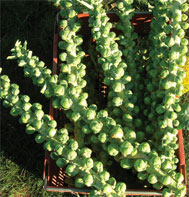 |
| |
Vegetable Garden � Tips on Growing Brussels Sprout From Seed
Days to Maturity: 92-120 DaysBrussels sprouts are a slow-growing, cool season crop that is a sun-loving long-bearing plant. The ideal climate is the "fog belt" of the Pacific Northwest, but they will grow in just about any part of the country. Plant in mid- to late summer for a crop that matures in the fall. The small heads mature best in cool and even in light frosty weather. Spring planting is also fine in cooler climates. Be aware that sprouts maturing in hot or dry weather will be flimsy and bitter.
Brussels sprouts also will need more boron than most other vegetables. Boron is a plant nutrient used in minute quantities by all plants; without it, Brussels sprouts develop hollow stems and small buds. If your plants have shown these symptoms, you can add boron to the soil by dissolving 1 level tablespoon of borax (such as 20 Mule Team from the grocery shelf) in 5 quarts of water and sprinkling it evenly over 50 square feet of bed. DO NOT be tempted to mix more, because too much causes problems. Also, do not apply unless your plants have shown the deficiency symptoms we just mentioned.
- Planting Depth: 1/4"-1/2"
- Soil Temp. for Germ.: 55-80�F
- Days to Germ.: 3-8
- Plant Spacing: 12"-18"
- Days to Maturity: 95-110
- Full Sun
- Moderate Water
Rotation and Companion Planting
- Good companions: Beet, bush bean, carrot, celery, cucumber, lettuce, nasturtium, onion family, pea, potato, radish, spinach and tomato.
- Bad companions: Kohlrabi, pole beans and strawberry
To be sure about pH, test the soil with a pH meter. Apply fertilizer and lime using the results of the soil test as a guide.
- Soil pH is a measurement of the number of Hydrogen ions present in the soil solution along with as the acidity of the soil. When the soil pH is too acidic the nutrients that are present in the soil become locked-up or unavailable (low pH) or alkaline (high pH).
- Correcting the pH has the same effect as applying fertilizer as it unlocks plant nutrients already present.
- In the garden some garden plants thrive in acidic soils while others prefer an alkaline soil.
- The acidity or alkalinity of soil is a measurement by pH (potential Hydrogen ions). pH is a way to measure the amount of lime (calcium) contained in your soil, and the type of soil that you have.
To Measure Soil pH
It is recommended that you use a relatively inexpensive, and follow the manufacturers instructions when testing the pH Level of your Gardens soil. To raise or lower the pH level in the soil either Limestone or Sulfur is utilized. Other materials will accomplish the same results; however the two that are listed are the most commonly used.Limestone is added to the soil to raise the pH level because limestone is essentially calcium and calcium reacts with water in the soil to yield hydroxyl ions .. a process known as, hydrolysis = thus the pH level in the soil is raised.
Sulfur reacts with bacteria in the soil and produces sulfuric acid, which releases hydrogen ions thus causing the soil to become more acidic =the pH level is lowered.
Application Of Lime (To Raise Soil pH)
To increase your pH by 1.0 point and make your soil more alkaline.
- Add 4 ounces of hydrated lime per square yard in sandy soils
- Add 8 ounces of hydrated lime per square yard in loamy soils
- Add 12 ounces of hydrated lime per square yard in clay soils
- Add 25 ounces of hydrated lime per square yard in peaty soils
- The addition of ash, bone meal, or crushed oyster shells will also help to raise soil pH levels.
Application of Sulfur (To Lower Soil pH)
If your soil needs to be more acidic, sulfur will lower the pH if it is available.
To reduce the soil pH by 1.0 point
- Mix in 1.2 oz of ground rock sulfur per square yard if the soil is sandy
- Mix in 3.6 oz per square yard for all other soils.
- Composted leaves, wood chips, sawdust, leaf mold and peat moss, will also help to lower the soil pH.
Brussels sprouts get large, so they need to be about 24 inches apart in a row or bed. If planted in rows, space rows 30 inches apart to give you enough room to walk. Do not let transplants sit around for long, dry out, or they will get stunted in their pack. So plant right away.
Plant deeply so that only one half to one third of the plant is left above the soil. Water thoroughly after planting to encourage good growth. After planting, water with a starter fertilizer solution of fish emulsion or 20-20-20 mixed according to label directions. Mulch to keep the ground cool and moist. Water regularly, applying 1 to 1 1/2 inches of water a week in lieu of rain.
Sprouts first form at the bottom of the plant and continue forming toward the top for several weeks. Brussels sprouts are ready to harvest when the tiny heads are firm, green, and 1 to 2 inches in diameter. Remove sprouts by twisting them until they break away from the plant.
Leaf removal works by driving the energy of the plant into sprout growth, there are 2 ways to do this with 2 different results. A home gardener may wish to remove minimal leaves, this will give you more sprouts over a longer period of time, but only a few at a time on each plant. Just remove the bottom two or three rows of leaves, either cutting or snapping them off carefully so you do not damage the sprouts at the axils. Harvest the bottom sprouts as soon as they are about an inch in diameter. Then as each successive sprout reaches harvestable size remove the leaves below it and cut or twist off the sprout, leaving a small spur of stem on the plant. In a long mild fall, these spurs might produce another crop.
Or the commercial version is a bit drastic but this is how to do it, watch until the sprouts at the bottom are 1/2 to 3/4 inch in diameter. Then remove the top of the plant-including the growing point and the top rosette of leaves with it's tiny sprouts. The plant will now concentrate on the sprouts at hand - which will be ready in about one month. As long as it has its growing point and sprouts leaves and sprouts until daytime temperatures stay below 45 F, it will yield small harvests every 10 days or so for about 2 months. The sprouts that are the tastiest are improved by a light frost.
As you remove the lower sprouts, you can also remove yellowing leaves; the plant continues to grow upward, producing more leaves and sprouts. The plant will withstand frost and can be harvested until a hard freeze strikes. The best-quality sprouts are produced during sunny days with light frosts at night. As winter approaches, you can trick the sprouts into maturing all at once by cutting off the top of the plant about 3 weeks before you want to harvest.
One full-sized, healthy plant can bear 2 to 3 pounds of sprouts. They come quickly at first but will slow down as the weather gets colder. Full-grown sprouts keep well on the plant in cold weather, making them a great winter harvest item for gardeners in the South (planted in fall). In cold climates, gardeners often bury Brussels sprouts plants up to their tops in hay or leaves in late fall, then pull off the little sprouts as needed through winter.