

|

|

|

|

|

|

|

|
 Read Our Blog
 Find Us On Facebook
 Follow 2BSeeds On Twitter
Gourmet Sauces, Gluten and MSG-Free - Recipes - Gourmet made easy
Free Tomato Seeds for the Unemployed
Open Pollinated Vegetable Seeds
Annual Flower Seeds
· Ageratum Seeds
· Alyssum Seeds
· Amaranthus Seeds
· Aster Seeds
· Baby's Breath Seeds
· Bachelor's Button Seeds
· Balsam Seeds
· Bells of Ireland Seeds
· Black Eyed Susan Seeds
· Calendula Seeds
· Campanula Seeds
· Carnation Seeds
· Celosia Seeds
· Cleome Seeds
· Coleus Seeds
· Cosmos Seeds
· Dahlberg Daisy Seeds
· Dahlia Seeds
· Dianthus Seeds
· Dusty Miller Seeds
· Eragrostis Seeds
· English Wallflower Seeds
· Forget-Me-Not Seeds
· Four O'Clocks Seeds
· Gazania Seeds
· Geranium Seeds
· Godetia Seeds
· Gomphrena Seeds
· Helichrysum Seeds
· Hollyhock Seeds
· Hyacinth Bean Vine Seeds
· Impatiens Seeds
· Iresine Seeds
· Isolepis Seeds
· Lavatera Seeds
· Lobelia Seeds
· Marigold Seeds
· Millet Seeds
· Mimulus Seeds
· Moonflower Seeds
· Morning Glory Seeds
· Nasturtium Seeds
· Nemesia Seeds
· Nicotiana Seeds
· Nierembergia Seeds
· Nigella Seeds
· Orchid Flower Seeds
· Ornamental Kale Seeds
· Ornamental Pepper Seeds
· Osteospermum Seeds
· Pansy Seeds
· Pentas Seeds
· Petunia Seeds
· Phlox Seeds
· Poached Egg Plant Seeds
· Pocketbook Plant Seeds
· Poppy Seeds
· Portulaca Seeds
· Ptilotus Seeds
· Rudbeckia Seeds
· Salvia Seeds
· Snapdragon Seeds
· Statice Seeds
· Stock Seeds
· Sunflower Seeds
· Sweet Pea Seeds
· Tithonia Seeds
· Torenia Seeds
· Verbena Seeds
· Vinca Seeds
· Viola Seeds
· Zinnia Seeds
Perennial Flower Seeds
Organic Vegetable Seeds
Vegetable Seeds
Container Patio Vegetable Seeds
Herb Seeds
Flowers for Bees
Wildflower Seed Mixes
Fuseables Flower Seed Mixes
Seed Collections
Bee's Select Seeds
· Select Flower Seeds
· Select Herb Seeds
· Select Vegetable Seeds
Hummingbird and Butterfly Gardens
Customer Care
· 2B Seeds Home
· About Us
· Contact Us
· Become a Member
· Customer Testimonials
· Our Newsletter
· How to Order
· Check the Status of Your Order
· Zone Map
· Vegetable Seed Sowing Chart
· Starting Fall Crops
· Flower Seeds
· Shipping Info
· Security Policy
· Our Guarantee
· Download Order Form
· Seed Resources & Gardening Information
· 2B Seeds Press
· Sitemap
| Join Our Mailing List |


| You are here: 2B Seeds Home > Annual Flower Seeds R-Z > Zinnia Seeds > Zahara Yellow F1 Zinnia Seeds |
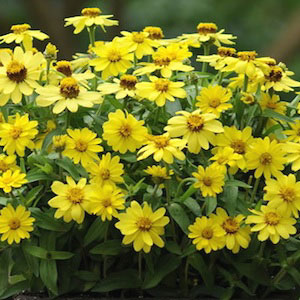
Zahara Yellow F1 Zinnia SeedsZinnia marylandicaNEW! Zahara varieties have larger flowers comparing to the Profusion series with more colors. Full bushy plants are covered with vibrant flowers that will make a statement in your garden. Heat tolerant and is a sun-loving that has bred in resistance to leaf spot and mildew diseases. Great for container gardens as well as flower gardens. Basil branching plants that create a plant habit that is completely covered with buds, then burst into beautiful flowers on a 12" spread. Height 12-14". 25 Seeds Per Package. |
|
|
|
Flower Garden - Tips on Growing Zinnia From Seed
Stage 1=Radicle (Embryonic Root)
- Germination temperature: 70 to 78�F
- Light is not required for germination.
- Cover the seed with a medium layer of soil mix or vermiculite at sowing.
- Start by using individual seed starting pots with a commercial seed-starting mix. Moisten the mix and let it drain. If you are using peat pots, sow three to four seeds in each pot.
- Cover the seeds lightly with a layer of mix or vermiculite and spritz the mix with enough water to moisten it slightly. Enclose the pots in a plastic bag closed with a twist tie to keep the mix from drying out while the seeds are germinating, or use a tray with a dome. Set the flat in a warm, bright location or under grow lights.
- Keep the growing medium at about 70-78F. Seedlings should emerge in 6 to 10 days. Remove the plastic cover and keep the mix evenly moist-not soggy-by watering the flat from the bottom to prevent water getting on the foliage.
Stage 2 =First Leaves
- Temperature: 70 to 75�F days; 60 to 65� F nights.
- Media Moisture: Keep the media medium (level 3) to medium wet (level 4).
- Fertilizer: Apply fertilizer at rate 1 less than 100 ppm N/less than 0.7 EC with a nitrate-form fertilizer with low phosphorous.
Stage 3=True Leaves
- Temperature: 70 to 75�F days; 60 to 65� F nights.
- Media Moisture: Keep the media medium wet (level 3) during Stages 3 and 4. Fertilizer: Increase the fertilizer rate to 2 -100 to 175 ppm. .7 to 1.2 EC)
- Maintain a media pH of 5.8 to 6.2 and EC at 0.7 to 1.0
- When the seedlings have at least two sets of true leaves, transplant them into individual 2 �-inch or larger pots. Provide as much sunlight as possible so the young plants do not get leggy from stretching reaching for the sun.
Stage 4- Ready to Finish
- Temperature: 65 to 70�F days; 60 to 65� F nights
- Fertilizer: Same as Stage 3.
- When the seedlings have two pairs of leaves, thin them to the correct spacing. If you carefully pull out the unwanted seedlings, you can transplant them to other parts of the garden. Otherwise, simply snip off the seedlings at ground level.
Finish
- Night: 60 to 65�F, Day: 65 to 70�F
- Keep light levels as high as possible while maintaining appropriate temperatures.
- Starting 1 week after transplant, apply fertilizer at rate 3 -175 to 225 ppm N/1.2 to 1.5 using predominantly nitrate-form fertilizer with low phosphorus. If needed, alternate with a balanced ammonium and nitrate-form fertilizer to encourage growth and balance the media pH. Maintain the media EC at 1.50 to 2.00 and pH at 5.8 to 6.2.
- 11 to 12 weeks in Spring, 8 to 9 weeks in Summer Crop time will be shorter under long days than under short days. Plant zinnias outdoors when the weather and soil have warmed up, about the time you plant impatiens or peppers. Sowing seeds directly in the garden. Along with some other annuals such as marigolds, zinnias do very well if you sow them outdoors right where you want them to grow. Wait to sow until all danger of frost has passed and the air and soil are warm.
- Zone 1 -July 15th -June 15th
- Zone 2 -August 15th- May 15th
- Zone 3 -September 15th May 15th
- Zone 4 -September 15th May 15th
- Zone 5 -October 15th April 15th
- Zone 6 -October 15th April 15th
- Zone 7 -October 15th April 15th
- Zone 8 -November 15th March 15th
- Zone 9 -December 15th February 15th
- Zone 10 -December 15th January 31st (sometimes earlier)
- Zone 11 _No frost. No frost.
- EC=Electrical Conductivity
- FC=Foot Candles
- PPM=Parts Per Million
Temperature:
Light:
Fertilizer:
Total growing time (sow to flower):
USDA Hardiness Zone -First Frost Date- Last Frost Date
Terms and their meaning:
Plant injury resulting from excessive soluble salts may first occur as a mild chlorosis of the foliage, later progressing to a necrosis of leaf tips and margins. This type of injury is largely attributed to the mobility of soluble salts within the plant. As these salts are rapidly translocated throughout the plant, they accumulate at the leaf tips and margins. Once the salts reach a toxic level they cause the characteristic "burn" associated with excessive salts. For an accurate reading get an EC meter. Soluble salts in irrigation water are measured in terms of electrical conductivity (EC). The higher the salt content the greater the EC. In general EC values exceeding 2.0 are considered toxic to plant growth. Monitor your water quality frequently in order to avoid potential problems from soluble salts.
Light intensity is a primary factor in the photosynthesis of all plants. Full unobstructed sunlight has an intensity of about 10,000 fc. Where as an overcast day will produce an intensity of around 1,000 fc. A window sill or light around a window or patio glass door can range from 100 to 5,000 depending of course what direction the light source is facing, or the time of year and your latitude.
This unit of measure is relatively unique to the greenhouse industry and often there is some confusion on how ppm is calculated.
I. To calculate the ppm contained in 1 ounce of material first solve for B:
A x 75 = B
A = the % active ingredient (AI) in the fertilizer
B = ppm contained in 1 ounce of the material in 100 gallons of water
Example: Calcium nitrate contains 15% N (0.15 x 75 = 11.25). If 1 ounce of calcium nitrate is dissolved in 100 gallons of water the solution will contain a II. To calculate the number of ounces of material required to make up a desired ppm concentration solve for C:
C = Desired ppm conc. / B
B = ppm contained in 1 ounce of the material in 100 gallons of water (from above).
C = number of ounces of material to add to 100 gallons of water to achieve the desired concentration.
Example: To make up a 250 ppm solution of calcium nitrate first multiply the AI x 75 (.15 x 75 = 11.25). Next divide the desired concentration by 11.25 (250/11.25 = 22). To make up a 250 ppm solution of calcium nitrate you would add 22 ounces to 100 gallons of water.
aproximately 11.25 ppm N.