

|

|

|

|

|

|

|

|
 Read Our Blog
 Find Us On Facebook
 Follow 2BSeeds On Twitter
Gourmet Sauces, Gluten and MSG-Free - Recipes - Gourmet made easy
Free Tomato Seeds for the Unemployed
Open Pollinated Vegetable Seeds
Bee's Select Flower Seeds
· Blue Ageratum Seeds
· White Alyssum Seeds
· Red Celosia Seeds
· Yellow Celosia Seeds
· Rose Coleus Seeds
· Cosmos Mix Seeds
· Cherry Dianthus Seeds
· Dianthus Mix Seeds
· Gazania Mix Seeds
· Impatiens Mix Seeds
· Violet Impatiens Seeds
· White Impatiens Seeds
· Trailing Mix Lobelia Seeds
· Yellow Red Marigold Seeds
· Single Mix Marigold Seeds
· Orange Marigold Seeds
· Large Yellow Marigold Seeds
· Marigold Mix Seeds
· Blue Morning Glory Seeds
· White Morning Glory Seeds
· Nicotiana Seeds
· Pansy Mix Seeds
· Light Blue Pansy Seeds
· Light Fruit Pansy Seeds
· White Petunia Seeds
· Blue Petunia Seeds
· Red Petunia Seeds
· Purple Petunia Seeds
· Rose Petunia Seeds
· Poppy Mix Seeds
· Moss Rose Mix Seeds
· Red Salvia Seeds
· Salvia Mix Seeds
· Blue Salvia Seeds
· Short Snapdragon Seeds
· Medium Snapdragon Seeds
· Tall Snapdragon Seeds
· Stock Mix Seeds
· Tall Yellow Sunflower Seeds
· Edible Sunflower Seeds
· Bi-Color Sunflower Seeds
· Short Yellow Sunflower Seeds
· Verbena Mix Seeds
· Vinca Mix Seeds
· Red Vinca Seeds
· Old Fashioned Viola Seeds
· Lilac Yellow Viola Seeds
· Primrose Viola Seeds
· Tall Yellow Zinnia Seeds
· Tall Red Zinnia Seeds
· Tall Purple Zinnia Seeds
· Zinnia Short Mix Seeds
· Zinnia Tall Mix Seeds
Annual Flower Seeds
Perennial Flower Seeds
Organic Vegetable Seeds
Vegetable Seeds
Container Patio Vegetable Seeds
Herb Seeds
Flowers for Bees
Wildflower Seed Mixes
Fuseables Flower Seed Mixes
Seed Collections
Bee's Select Seeds
· Select Flower Seeds
· Select Herb Seeds
· Select Vegetable Seeds
Hummingbird and Butterfly Gardens
Customer Care
· 2B Seeds Home
· About Us
· Contact Us
· Become a Member
· Customer Testimonials
· Our Newsletter
· How to Order
· Check the Status of Your Order
· Zone Map
· Vegetable Seed Sowing Chart
· Starting Fall Crops
· Flower Seeds
· Shipping Info
· Security Policy
· Our Guarantee
· Download Order Form
· Seed Resources & Gardening Information
· 2B Seeds Press
· Sitemap
| Join Our Mailing List |


| You are here: 2B Seeds Home > Select Flower Seeds T-Z > Primrose Viola Select Seeds |
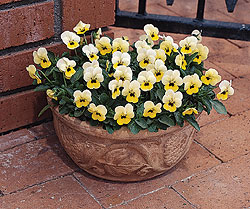
Primrose Viola Select SeedsOur Primrose Viola Select Seeds produce a free flowering viola that grows across a wide range of conditions, from spring to autumn. You can expect success from these carefuly selected Primrose Viola Select seeds. These vigorous, strong absolute winners have been chosen to meet your highest expectations. They have been tested nation-wide for great garden performance in all parts of our country. |
|
|
|
Flower Garden � Tips on Growing Viola From Seed
Botanically speaking, violas, pansies, and almost all violets are perennials belonging to the genus Viola. However, violas and pansies are usually treated as annuals, invaluable for winter and spring bloom in mild winter areas or zones, and for spring through summer in colder climates.SPECIAL GERMINATION INSTRUCTIONS:
- Viola seeds are easy to germinate, however, Violas will do better with stratification, a process of subjecting seeds to moist/cold treatment to break the seeds dormancy.
- Indoors, sow seeds into moistened soil and place in the refrigerator or freezer for about 5 days. Seeds can then be germinated. Viola seed also requires darkness to germinate.
- Make sure seeds are planted at recommended depth of 1/8"."
Stage 1
Germination: 68�F (20�C)
- Light is not required for germination.
- A medium covering of coarse grade vermiculite is recommended to help maintain high humidity around the germinating seed for better germination performance.
- Proper germination takes 3 to 4 days.
- For optimal germination performance, maintain the plug media at �wet� moisture levels, i.e., the media is glistening, but water will not ooze out from the bottom of the tray and will penetrate only slightly from the top around the fingertip.
- Avoid germination temperatures above 70�F (21�C) to prevent seedling stretch.
Stage 2 (first leaves) timing: 10 days
- Maintain 95 to 97% relative humidity.
- Maintain an EC of 0.5 to 0.75 and a pH of 5.4 to 5.8.
- Temperature 65� to 70�F (18 to 21�C) days; 60�F (15�C) Nights.
Stage 3 timing: (true leaves) 14 days
- Maintain 95 to 97% relative humidity.
- Beginning at Stage 3, reduce the moisture level in the media once the seedlings are established.
- Temperature 65�F (18�C) days; 60�F (15�C) nights.
- Maintain an EC and pH values can be at 1.0 and 5.6 to 5.8, respectively. A high pH (greater than 6.0) can induce boron deficiency and also encourages fungal black root rot, caused by Thielaviopsis sp.
Stage 4(plug finish) 7 days
- Plugs can be grown under wet/dry cycles to tone the seedlings and avoid soft growth.
- Maintain 95 to 97% relative humidity. Stage 4: 60�F (15�C) days; 55�F (13�C) nights.
- Fertilize the seedlings twice a week with 50 ppm N from 14-0-14, alternating with a 20-10-20 type fertilizer for pH balance and supplying the required calcium. Increase the nitrogen concentration to 100 ppm after a week, and continue this program transplant.
- Maintain an EC and pH values can be at 1.0 and 5.6 to 5.8, respectively. A high pH (greater than 6.0) can induce boron deficiency and also encourages fungal black root rot, caused by Thielaviopsis sp.
- Zone 1 -July 15th -June 15th
- Zone 2 -August 15th- May 15th
- Zone 3 -September 15th May 15th
- Zone 4 -September 15th May 15th
- Zone 5 -October 15th April 15th
- Zone 6 -October 15th April 15th
- Zone 7 -October 15th April 15th
- Zone 8 -November 15th March 15th
- Zone 9 -December 15th February 15th
- Zone 10 -December 15th January 31st (sometimes earlier)
- Zone 11 _No frost. No frost.
- Plant injury resulting from excessive soluble salts may first occur as a mild chlorosis of the foliage, later progressing to a necrosis of leaf tips and margins. This type of injury is largely attributed to the mobility of soluble salts within the plant. As these salts are rapidly translocated throughout the plant, they accumulate at the leaf tips and margins. Once the salts reach a toxic level they cause the characteristic "burn" associated with excessive salts. For an accurate reading get an EC meter.
- Soil pH is a measurement of the number of Hydrogen ions present in the soil solution along with as the acidity of the soil. When the soil pH is too acidic the nutrients that are present in the soil become locked-up or unavailable (low pH) or alkaline (high pH).
- Correcting the pH has the same effect as applying fertilizer as it unlocks plant nutrients already present. In your garden some garden plants thrive in acidic soils while others prefer an alkaline soil. The acidity or alkalinity of soil is a measurement by pH (potential Hydrogen ions). pH is a way to measure the amount of lime (calcium) contained in your soil, and the type of soil that you have.
- Add 4 ounces of hydrated lime per square yard in sandy soils
- Add 8 ounces of hydrated lime per square yard in loamy soils
- Add 12 ounces of hydrated lime per square yard in clay soils
- Add 25 ounces of hydrated lime per square yard in peaty soils
- The addition of ash, bone meal, or crushed oyster shells will also help to raise soil pH levels.
- Mix in 1.2 oz of ground rock sulfur per square yard if the soil is sandy
- Mix in 3.6 oz per square yard for all other soils.
- Composted leaves, wood chips, sawdust, leaf mold and peat moss, will also help to lower the soil pH.
USDA Hardiness Zone -First Frost Date- Last Frost Date
EC=Electrical Conductivity
To Measure Soil pH
It is recommended that you use a relatively inexpensive, and follow the manufacturers instructions when testing the pH Level of your Gardens soil. To raise or lower the pH level in the soil either Limestone or Sulfur is utilized. Other materials will accomplish the same results; however the two that are listed are the most commonly used.Limestone is added to the soil to raise the pH level because limestone is essentially calcium and calcium reacts with water in the soil to yield hydroxyl ions .. a process known as, hydrolysis = thus the pH level in the soil is raised.
Sulfur reacts with bacteria in the soil and produces sulfuric acid, which releases hydrogen ions thus causing the soil to become more acidic =the pH level is lowered.