

|

|

|

|

|

|

|

|
 Read Our Blog
 Find Us On Facebook
 Follow 2BSeeds On Twitter
Gourmet Sauces, Gluten and MSG-Free - Recipes - Gourmet made easy
Free Tomato Seeds for the Unemployed
Open Pollinated Vegetable Seeds
Organic Vegetable Seeds
· Organic Artichoke Seeds
· Organic Arugula Seeds
· Organic Basil Seeds
· Organic Bush Bean Seeds
· Organic Beet Seeds
· Organic Broccoli Seeds
· Organic Cabbage Seeds
· Organic Carrot Seeds
· Organic Cauliflower Seeds
· Organic Celery Seeds
· Organic Chard Seeds
· Organic Chives Seeds
· Organic Corn Seeds
· Organic Cucumber Seeds
· Organic Dill Seeds
· Organic Eggplant Seeds
· Organic Epazote Seeds
· Organic Fennel Seeds
· Organic Kale Seeds
· Organic Leek Seeds
· Organic Lettuce Seeds
· Organic Marjoram Seeds
· Organic Melon Seeds
· Organic Okra Seeds
· Organic Onion Seeds
· Organic Pea Seeds
· Organic Pepper Seeds
· Organic Radish Seeds
· Organic Sage Seeds
· Organic Spinach Seeds
· Organic Squash Seeds, Summer
· Organic Squash Seeds, Winter
· Organic Stevia Seeds
· Organic Thyme Seeds
· Organic Tomatillo Seeds
· Organic Tomato Seeds
· Organic Watermelon Seeds
All Vegetable Seeds
Container Patio Vegetable Seeds
Annual Flower Seeds
Perennial Flower Seeds
Herb Seeds
Flowers for Bees
Wildflower Seed Mixes
Fuseables Flower Seed Mixes
Seed Collections
Bee's Select Seeds
· Select Flower Seeds
· Select Herb Seeds
· Select Vegetable Seeds
Hummingbird and Butterfly Gardens
Customer Care
· 2B Seeds Home
· About Us
· Contact Us
· Become a Member
· Customer Testimonials
· Our Newsletter
· How to Order
· Check the Status of Your Order
· Zone Map
· Vegetable Seed Sowing Chart
· Starting Fall Crops
· Flower Seeds
· Shipping Info
· Security Policy
· Our Guarantee
· Download Order Form
· Seed Resources & Gardening Information
· 2B Seeds Press
· Sitemap
| Join Our Mailing List |


| You are here: 2B Seeds Home > Organic Vegetable Seeds > Organic Swiss Chard Seeds, Red Ruby |
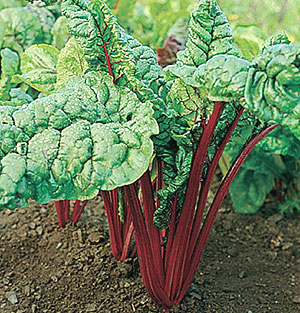
Organic Swiss Chard Seeds, Red RubyBeta vulgaris, vulgaris groupThis chard is beautiful in your salad! Red Ruby organic chard seeds produce candy apple red stems with dark green leaves with red veins. Also called Rhubarb Chard, it is an heirloom with a sweet and tender rhubarb-like stalk. It has been said that the leaves are tastier than spinach with a crunch like celery from the stalk itself. This chard can tolerate shade and will not get bitter in hot weather. 32 days to maturity for baby and 59 days for bunching. Grown Organically. 225 seeds per pkg. |
|
|
|
Vegetable Garden - -Tips on Growing Swiss Chard From Seeds
Days to Maturity: 50-60- Chard thrives well on any soil where lettuce and spinach will grow.
- Once the soil can be worked on after the last frost (April - May), plant the seeds directly in the ground, 1/2 to 1 inch deep.
- Space the seeds 4 to 6 inches apart.
- Water frequently.
- Like other leafy vegetables, chard leaves are easily attacked by pests.
- Remove and destroy affected leaves at once so the problem does not spread.
- Chard can grow 1-1/2 to 2 feet tall with crinkled leaves that have prominent central ribs.
- Pick the leaves while they are young and tender. Remove the outer leaves without first. Cut or pull the leaves at the base of the plant by pulling downwards and twisting them off. Leave the inner leaves to grow to harvest on a later date.
- Discard any old leaves. They will decrease production if left on the plant.
- Unlike most vegetables, Swiss chard can tolerate a little shade and won�t get bitter in hot weather.
Swiss Chard Bright Lights was an All America Selections winner in 1998.
When to plant outside: RECOMMENDED.
- Early spring, 2-4 weeks before the average last frost date or when soil temperature reaches 50 degrees.
- A spring planting will go on producing through spring, summer, and fall until a hard freeze kills it.
USDA Hardiness Zone -First Frost Date- Last Frost Date
- Zone 1 -July 15th -June 15th
- Zone 2 -August 15th- May 15th
- Zone 3 -September 15th May 15th
- Zone 4 -September 15th May 15th
- Zone 5 -October 15th April 15th
- Zone 6 -October 15th April 15th
- Zone 7 -October 15th April 15th
- Zone 8 -November 15th March 15th
- Zone 9 -December 15th February 15th
- Zone 10 -December 15th January 31st (sometimes earlier)
- Zone 11 -No frost. No frost.
When to start inside: Not recommended.
Special Sowing & Germination Instructions:
- Soak seeds in water for 24 hours before planting.
- Chard seed is actually a dried fruit with 1-5 seeds in each fruit. Therefore, thinning instructions are very important.
- Plant seed �� deep and 2� apart. If several seedlings emerge from 1 fruit in the same spot, immediately thin to 1 seedling per 2�.
- After 3-4 weeks, thin to 1 seedling per 8�.
- Thinned seedlings can be used in that evening�s salad.
- Do not allow a crust to build up on the soil surface which will cause seedlings to struggle to come up.
- Cultivate lightly and mulch the soil surface when seedlings are 2� high.
Garden Hints:
- Swiss chard grows best in rich, moist soil with a pH between 6.0 and 6.8.
- Plant in fertile soil as you want the plants to grow fast so they will produce tender leaves.
- Work nitrogen-rich amendments such as blood meal, cottonseed meal, feather meal, or composted manure into the ground before planting. Or, apply a timed-release vegetable food such as 14-14-14 according to label directions.
- Space transplants about a foot apart. After planting, water the transplants well and apply a liquid starter fertilizer.
To be sure about pH, test the soil with a pH meter. Apply fertilizer and lime using the results of the soil test as a guide.
- Soil pH is a measurement of the number of Hydrogen ions present in the soil solution along with as the acidity of the soil. When the soil pH is too acidic the nutrients that are present in the soil become locked-up or unavailable (low pH) or alkaline (high pH).
- Correcting the pH has the same effect as applying fertilizer as it unlocks plant nutrients already present.
- In the garden some garden plants thrive in acidic soils while others prefer an alkaline soil.
- The acidity or alkalinity of soil is a measurement by pH (potential Hydrogen ions). pH is a way to measure the amount of lime (calcium) contained in your soil, and the type of soil that you have.
To Measure Soil pH
It is recommended that you use a relatively inexpensive, and follow the manufacturers instructions when testing the pH Level of your Gardens soil. To raise or lower the pH level in the soil either Limestone or Sulfur is utilized. Other materials will accomplish the same results; however the two that are listed are the most commonly used.Limestone is added to the soil to raise the pH level because limestone is essentially calcium and calcium reacts with water in the soil to yield hydroxyl ions .. a process known as, hydrolysis = thus the pH level in the soil is raised.
Sulfur reacts with bacteria in the soil and produces sulfuric acid, which releases hydrogen ions thus causing the soil to become more acidic =the pH level is lowered.
Application Of Lime (To Raise Soil pH)
To increase your pH by 1.0 point and make your soil more alkaline.
- Add 4 ounces of hydrated lime per square yard in sandy soils
- Add 8 ounces of hydrated lime per square yard in loamy soils
- Add 12 ounces of hydrated lime per square yard in clay soils
- Add 25 ounces of hydrated lime per square yard in peaty soils
- The addition of ash, bone meal, or crushed oyster shells will also help to raise soil pH levels.
Application of Sulfur (To Lower Soil pH)
If your soil needs to be more acidic, sulfur will lower the pH if it is available.
To reduce the soil pH by 1.0 point
- Mix in 1.2 oz of ground rock sulfur per square yard if the soil is sandy
- Mix in 3.6 oz per square yard for all other soils.
- Composted leaves, wood chips, sawdust, leaf mold and peat moss, will also help to lower the soil pH.
Do water regularly, especially in summer, as drought-stressed plants may bolt, or flower.
Leaves are the sweetest and most tender in the cool of early spring and fall.
You can begin harvesting outer leaves anytime that they are large enough to eat; young tender leaves are the most flavorful and make a colorful addition to salads. If picked 1 or 2 leaves at a time, a spring planting of 6 to 12 plants will yield plenty of leaves into winter. Cut out the midrib of larger leaves before cooking or chopping into salads. Chop large leaves to cook down like spinach or in casseroles, soups, and pasta.
In areas that never experience a hard freeze, Swiss chard sometimes behaves like a perennial, living for several years. When it blooms, you can cut off the bloom stalk and it will produce more leaves.
Whole harvested leaves will keep in the refrigerator for about 2 weeks in a loose plastic bag or sealed container.
Plants are generally problem free but may be attacked by aphids, mites, and caterpillars that chew holes in the leaves. Swiss chard is also subject to cercospora leaf spot, a disease that disfigures the leaves with ash-gray spots that have purple edges; or leaves may get downy mildew, which causes a mildew-like growth on the foliage.