

|

|

|

|

|

|

|

|
 Read Our Blog
 Find Us On Facebook
 Follow 2BSeeds On Twitter
Gourmet Sauces, Gluten and MSG-Free - Recipes - Gourmet made easy
Free Tomato Seeds for the Unemployed
Open Pollinated Vegetable Seeds
Organic Vegetable Seeds
· Organic Artichoke Seeds
· Organic Arugula Seeds
· Organic Basil Seeds
· Organic Bush Bean Seeds
· Organic Beet Seeds
· Organic Broccoli Seeds
· Organic Cabbage Seeds
· Organic Carrot Seeds
· Organic Cauliflower Seeds
· Organic Celery Seeds
· Organic Chard Seeds
· Organic Chives Seeds
· Organic Corn Seeds
· Organic Cucumber Seeds
· Organic Dill Seeds
· Organic Eggplant Seeds
· Organic Epazote Seeds
· Organic Fennel Seeds
· Organic Kale Seeds
· Organic Leek Seeds
· Organic Lettuce Seeds
· Organic Marjoram Seeds
· Organic Melon Seeds
· Organic Okra Seeds
· Organic Onion Seeds
· Organic Pea Seeds
· Organic Pepper Seeds
· Organic Radish Seeds
· Organic Sage Seeds
· Organic Spinach Seeds
· Organic Squash Seeds, Summer
· Organic Squash Seeds, Winter
· Organic Stevia Seeds
· Organic Thyme Seeds
· Organic Tomatillo Seeds
· Organic Tomato Seeds
· Organic Watermelon Seeds
All Vegetable Seeds
Container Patio Vegetable Seeds
Annual Flower Seeds
Perennial Flower Seeds
Herb Seeds
Flowers for Bees
Wildflower Seed Mixes
Fuseables Flower Seed Mixes
Seed Collections
Bee's Select Seeds
· Select Flower Seeds
· Select Herb Seeds
· Select Vegetable Seeds
Hummingbird and Butterfly Gardens
Customer Care
· 2B Seeds Home
· About Us
· Contact Us
· Become a Member
· Customer Testimonials
· Our Newsletter
· How to Order
· Check the Status of Your Order
· Zone Map
· Vegetable Seed Sowing Chart
· Starting Fall Crops
· Flower Seeds
· Shipping Info
· Security Policy
· Our Guarantee
· Download Order Form
· Seed Resources & Gardening Information
· 2B Seeds Press
· Sitemap
| Join Our Mailing List |


| You are here: 2B Seeds Home > Organic Vegetable Seeds > Organic Broccoli Seeds, De Cicco |
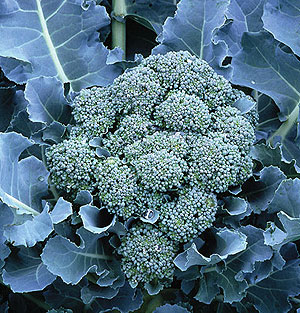
Organic Broccoli Seeds, De CiccoBrassica oleracea - italica groupThis is a very traditional organic broccoli seed variety that produces a small 3 - 4" main head that projects well above the foliage, followed by a large yield of side-shooting spears. Habit is non-uniform in maturity, which results in a long harvest period. This is a favorite multi-cut variety. You should harvest the main head when it is 3" in diameter or less to encourage heavier side shoot production. 45-48 days to harvest. Grown Organically. 100 seeds per pkg. |
|
|
|
Vegetable Garden - Tips on How To Grow Broccoli From Seed
55-98 Days to HarvestSTART INDOORS
An early start on this cool weather annual will give you fine quality green heads before the hot weather reigns.- Sow Broccoli seeds �" deep in seed starting formula, in a warm, well-lighted area about 5-7 weeks before planting outside. Keep evenly moist.
- Seedlings will emerge in 3-5 days at 70� F.
- They do best covered lightly with soil.
TRANSPLANT
- Transplant your seedlings outside 3-4 weeks before your last frost date.
- Transplant the Broccoli seedlings at least once into larger flats, and set out young Broccoli plants 18-24 inches apart, in rows about 24 inches apart.
- Broccoli plants spaced 10-12 inches apart will also yield well, however will have smaller heads.
- They will grow best at 60� to 65� F (16�-18�C).
- Do not let seedling become more than 5 weeks old because older seedlings do not mature well transplanted.
- Broccoli can withstand a frost down to about 25�F(-4�C.) Failure to produce heads can be caused by hot weather too soon, lack of water and low soil calcium.
- Set plants 18" apart in rows 24" apart. Transplant seedlings in late June through July for September through November head harvest.
Rotation and Companion Planting for Broccoli Seeds
- Good companions: Beet, bush bean, carrot, celery, chard, cucumber, dill, kale, lettuce, mint, nasturtium, onion family, oregano, potato, rosemary, sage, spinach and tomato.
- Bad companions: Pole, lima and snap beans, strawberry
GARDEN HINTS:
- Water deeply and thoroughly at least once a week in dry hot weather.
- Cultivate or mulch to control weeds.
- High fertility and an abundant supply of water throughout the growing season are very important.
- Broccoli is a hardy vegetable that develops best during cool seasons of the year.
- Two crops per year (spring and fall) are possible in most parts of the country, especially with continuous improvement in fast maturity and heat tolerance that extends the life of broccoli through all but the hottest parts of the season.
- Broccoli belongs to the cole crop family (Brassica oleracea), which includes cabbage, Brussels sprouts, cauliflower, collards, kale, and kohlrabi.
- Broccoli needs cool weather, full sun, water, feed and rich soil.
- Plant your broccoli where it will get least 6 hours of sun daily and has fertile, well-drained, moist soil with plenty of organic matter.
- Mulching will help keep the ground cool and moist.
- The soil pH should be between 6.0 and 7.0 for best growth and to discourage any club root disease.
Water regularly, applying 1 to 1.5 inches of water per week if it does not rain. You can also measure the amount of water you receive with a rain gauge left in place in the garden, and checked weekly it there is not any chance that it will dry out. If your soil is not naturally rich in nitrogen from an abundant amount of earthworms or by you adding a regular addition of organic, nitrogen-rich compost, then fertilize the plants again with a liquid fertilizer such as fish emulsion or a Herb and Vegetable Food as they begin to develop new leaves and continue liquid feeding until the heads are nearly ready to harvest.
When you begin to see a flower head forming in the center of the plant, check its growth every day. Ideally, you will harvest broccoli while the tiny buds are tightly closed. If the buds begin to swell or show yellow (the flower petals), cut the head from the stem right away, no matter how small it is, because the opening buds have a mealy texture. After cutting the main head, leave the plant to grow bite-sized side shoots in the axils of the leaves. Do not be disappointed if your broccoli head is smaller that those in the grocery store; they are grown in a friendly climate and with lots of pampering. In areas where spring heats up fast, broccoli heads are often better in fall than in spring, so try again for a bigger head later. You can do this by planting in late summer.
Broccolis are temperature sensitive. If transplants sit exposed in cold weather, let�s say below 40 degrees for a week or two, the chilling injury will trigger heads to form too early. On the other end of the scale, if you plant too late and the weather gets hot, you will get the same early blooming, so plant your broccoli on time. The ideal temperature for broccoli is between 65 and 80 degrees.
USDA Hardiness Zone -First Frost Date- Last Frost Date
- Zone 1 -July 15th -June 15th
- Zone 2 -August 15th- May 15th
- Zone 3 -September 15th May 15th
- Zone 4 -September 15th May 15th
- Zone 5 -October 15th April 15th
- Zone 6 -October 15th April 15th
- Zone 7 -October 15th April 15th
- Zone 8 -November 15th March 15th
- Zone 9 -December 15th February 15th
- Zone 10 -December 15th January 31st (sometimes earlier)
- Zone 11 -No frost. No frost.