

|

|

|

|

|

|

|

|
 Read Our Blog
 Find Us On Facebook
 Follow 2BSeeds On Twitter
Gourmet Sauces, Gluten and MSG-Free - Recipes - Gourmet made easy
Free Tomato Seeds for the Unemployed
Open Pollinated Vegetable Seeds
Annual Flower Seeds
· Ageratum Seeds
· Alyssum Seeds
· Amaranthus Seeds
· Aster Seeds
· Baby's Breath Seeds
· Bachelor's Button Seeds
· Balsam Seeds
· Bells of Ireland Seeds
· Black Eyed Susan Seeds
· Calendula Seeds
· Campanula Seeds
· Carnation Seeds
· Celosia Seeds
· Cleome Seeds
· Coleus Seeds
· Cosmos Seeds
· Dahlberg Daisy Seeds
· Dahlia Seeds
· Dianthus Seeds
· Dusty Miller Seeds
· Eragrostis Seeds
· English Wallflower Seeds
· Forget-Me-Not Seeds
· Four O'Clocks Seeds
· Gazania Seeds
· Geranium Seeds
· Godetia Seeds
· Gomphrena Seeds
· Helichrysum Seeds
· Hollyhock Seeds
· Hyacinth Bean Vine Seeds
· Impatiens Seeds
· Iresine Seeds
· Isolepis Seeds
· Lavatera Seeds
· Lobelia Seeds
· Marigold Seeds
· Millet Seeds
· Mimulus Seeds
· Moonflower Seeds
· Morning Glory Seeds
· Nasturtium Seeds
· Nemesia Seeds
· Nicotiana Seeds
· Nierembergia Seeds
· Nigella Seeds
· Orchid Flower Seeds
· Ornamental Kale Seeds
· Ornamental Pepper Seeds
· Osteospermum Seeds
· Pansy Seeds
· Pentas Seeds
· Petunia Seeds
· Phlox Seeds
· Poached Egg Plant Seeds
· Pocketbook Plant Seeds
· Poppy Seeds
· Portulaca Seeds
· Ptilotus Seeds
· Rudbeckia Seeds
· Salvia Seeds
· Snapdragon Seeds
· Statice Seeds
· Stock Seeds
· Sunflower Seeds
· Sweet Pea Seeds
· Tithonia Seeds
· Torenia Seeds
· Verbena Seeds
· Vinca Seeds
· Viola Seeds
· Zinnia Seeds
Perennial Flower Seeds
Organic Vegetable Seeds
Vegetable Seeds
Container Patio Vegetable Seeds
Herb Seeds
Flowers for Bees
Wildflower Seed Mixes
Fuseables Flower Seed Mixes
Seed Collections
Bee's Select Seeds
· Select Flower Seeds
· Select Herb Seeds
· Select Vegetable Seeds
Hummingbird and Butterfly Gardens
Customer Care
· 2B Seeds Home
· About Us
· Contact Us
· Become a Member
· Customer Testimonials
· Our Newsletter
· How to Order
· Check the Status of Your Order
· Zone Map
· Vegetable Seed Sowing Chart
· Starting Fall Crops
· Flower Seeds
· Shipping Info
· Security Policy
· Our Guarantee
· Download Order Form
· Seed Resources & Gardening Information
· 2B Seeds Press
· Sitemap
| Join Our Mailing List |


| You are here: 2B Seeds Home > Annual Flower Seeds C-D > Dahlia Seeds > Diablo Dahlia Seeds |
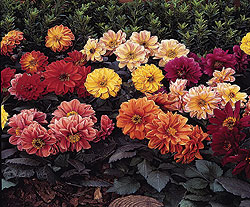
Diablo Dahlia SeedsFull Double Flowers with dark bronze leaves make it an excellent choice for the garden. 15" in height in colors of carmine, orange, yellow and pink. If sowing indoors do so early and transplant seedlings after all danger of frost, or direct sow in place in warm soil. Package (35 seeds). |
|
|
|
Flower Garden - Tips on Growing Dahlia From Seeds
Dahlia�s have become tremendously diversified and available in numerous flower types and sizes. Dahlia flowers are composite (daisylike) blooms containing many individual flowers called florets. Modern Dahlias, with their strong stems, long lasting blooms that face outward or upward, attractive foliage are being used as cut flowers.Germination
- Optimum conditions for seedling development that begins the day the crop is sown until cotyledon expansion.
- Expect radicle emergence in 2 days.
- Cover: Cover seeds with a thin layer of medium sized vermiculite to maintain moisture levels, as well as they do not need light for germination.
- Media: � pH: 5.5 � 5.8
- Light: Provide long days starting at sow. Dahlias want to form tubers under short days. Provide interrupted nights for a 12 � 14 hour day to suppress tuber formation.
- Temperature: 68� � 72�F (20� � 22�C) until radicle emergence. Reduce to 65� � 68�F (18� � 20�C) until cotyledon expansion.
- Moisture: Saturated (5) until days 2 � 3 or radicle emergence.
- On days 4 � 7, reduce to moisture level (4) Beginning day 8; start alternating moisture levels wet (4) and medium (2). Allow media to approach level (2) before re-saturating to level (4).
- Humidity: 100% until radicle emergence then reduce to 40 � 70%.
- Dehumidify: Provide horizontal airflow to aid in drying down the media through evapotranspiration, allowing better penetration of oxygen to the roots.
- Finish Bulking/Flower Initiation � Optimum conditions during the vegetative period, beginning at transplant, needed for the root to reach the edge of the container; AND to make the plant receptive to flower initiation.
- Media: � pH: 5.5 � 5.8
- Light: Provide long days. Interrupted nights may be needed to simulate long days. Flowering is inhibited by tuber formation, which is only influenced by day length. Days shorter than 12 hours will promote tuber formation instead of flowering.
- Temperature: For early spring flowering, optimal growth is best obtained by growing plants at 65� � 70�F (18� � 20�C) nights.
- Temperature influences the speed of growth and the overall quality of the habit. Temperatures cooler than 62�F (17�C) will slow growth and produce more compact plants, but be sure that interrupted nights or long days are provided to avoid tuber formation.
- Average Daily Temperature (ADT): 67� (19�C). ADT above 80�F (27�C) will inhibit or abort flower initiation.
- Time Frame when plants are receptive to flower initiation: Days 28 � 35; 5 � 7 leaves present.
- Flowering Type: Obligate Long Day Plant � long days are necessary for Flowering.
- Moisture: Alternate between moisture levels wet (4) and medium (2). Allow media to approach level (2) before re-saturating to level (4). Watering early in the day and providing good ventilation is important to producing a strong, healthy crop. Do not let plants wilt.
- Too little water will produce small plants.
- Humidity: 50%. Dahlias prefer low humidity.
- Light: Full sun
- USDA Hardiness Zone: 11
- Garden Height: 7 � 9 inches (17 � 23 cm)
- Garden Width: 7 � 9 inches (17 � 23 cm).
- Soil pH is a measurement of the number of Hydrogen ions present in the soil solution along with as the acidity of the soil. When the soil pH is too acidic the nutrients that are present in the soil become locked-up or unavailable (low pH) or alkaline (high pH).
- Correcting the pH has the same effect as applying fertilizer as it unlocks plant nutrients already present.
- In the garden some garden plants thrive in acidic soils while others prefer an alkaline soil.
- The acidity or alkalinity of soil is a measurement by pH (potential Hydrogen ions). pH is a way to measure the amount of lime (calcium) contained in your soil, and the type of soil that you have.
- Add 4 ounces of hydrated lime per square yard in sandy soils
- Add 8 ounces of hydrated lime per square yard in loamy soils
- Add 12 ounces of hydrated lime per square yard in clay soils
- Add 25 ounces of hydrated lime per square yard in peaty soils
- The addition of ash, bone meal, or crushed oyster shells will also help to raise soil pH levels.
- Mix in 1.2 oz of ground rock sulfur per square yard if the soil is sandy
- Mix in 3.6 oz per square yard for all other soils.
- Composted leaves, wood chips, sawdust, leaf mold and peat moss, will also help to lower the soil pH.
To be sure about pH, test the soil with a pH meter. Apply fertilizer and lime using the results of the soil test as a guide.
To Measure Soil pH
It is recommended that you use a relatively inexpensive, and follow the manufacturers instructions when testing the pH Level of your Gardens soil. To raise or lower the pH level in the soil either Limestone or Sulfur is utilized. Other materials will accomplish the same results; however the two that are listed are the most commonly used.Limestone is added to the soil to raise the pH level because limestone is essentially calcium and calcium reacts with water in the soil to yield hydroxyl ions .. a process known as, hydrolysis = thus the pH level in the soil is raised.
Sulfur reacts with bacteria in the soil and produces sulfuric acid, which releases hydrogen ions thus causing the soil to become more acidic =the pH level is lowered.