

|

|

|

|

|

|

|

|
 Read Our Blog
 Find Us On Facebook
 Follow 2BSeeds On Twitter
Gourmet Sauces, Gluten and MSG-Free - Recipes - Gourmet made easy
Free Tomato Seeds for the Unemployed
Open Pollinated Vegetable Seeds
Flowers for Bees
Fuseables Flower Seed Mixes
Wildflower Seed Mixes
Seed Collections
Fuseables Flower Seed Mixes
Kinder Garden Seeds
Customer Care
· Bee Feed Mix
· Honey Bee Pollinator
· Western Honey Bee Pollinator
· Eastern Honey Bee Pollinator
· More Bee Pollinator Seed Mixes >>
· Blueberry Lime Jam Petunia Seed Mix
· Flirtini Petunia Seed Mix
· Key Lime Parfait Petunia Seed Mix
· More »
· Blooming Color
· Midwest Wildflower
· Northeast Wildflower
· Pacific Northwest
· Southeast Wildflower
· Southwest Wildflower
· Western Wildflower
· North American Native
· All Annual Wildflower
· All Perennial Wildflower
· Butterflies and Birds
· Poppin' Poppies
· Everywhere Cosmos
· Coneflower Power
· Shade Tolerant
· Blazing Sunset
· Butterfly Garden
· Cool Blues
· Cut Flower
· Gourmet Herb
· Hummingbird Garden
· Pearls Garden
· Pipin Hot Chili Pepper
· Reds and Purples
· Salad Bowl
· Sunwave
· Tomato Lovers
Annual Flower Seeds
Perennial Flower Seeds
Herb Seeds
Vegetable Seeds
Organic Vegetable Seeds
Container Patio Vegetable Seeds
Bulk Seeds
Hummingbird and Butterfly Gardens
· 2B Seeds Home
· About Us
· Contact Us
· Become a Member
· Customer Testimonials
· Our Newsletter
· How to Order
· Check the Status of Your Order
· Zone Map
· Vegetable Seed Sowing Chart
· Starting Fall Crops
· Flower Seeds
· Shipping Info
· Security Policy
· Our Guarantee
· Download Order Form
· Seed Resources & Gardening Information
· 2B Seeds Press
· Sitemap
Join Our Mailing List


| You are here: 2B Seeds Home > Wildflower Seed Mixes > Blooming Color Wildflower Seed Mix |
Blooming Color Wildflower Seed MixAll of the seeds in this mix are suited for all regions of continental US.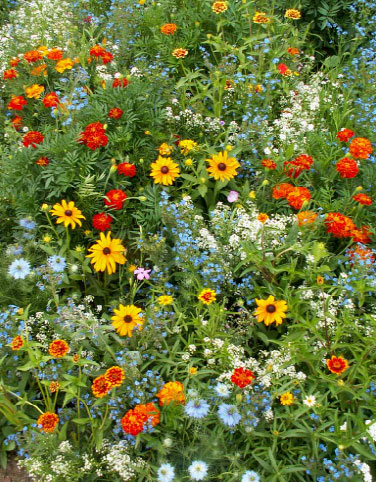
|
|
Not sure exactly which wildflowers you'd like to grow, but want a grand show of blooming color? Our Blooming Color Wildflower Seed Mix gives you gorgeous bloom without you needing to pick out specific seeds or regions. Containing 14 annual and perennial favorite wildflower seeds, this is a great choice for the general continental United States. Create that pretty cottage garden look with this colorful, airy display of mixed wildflowers. Find the right amount for your garden space by reading the text below. This Blooming Color Wildflower Seed Mix includes:
Tips On Growing Wildflowers - How Much To Plant, How To Care For
Them
General Information on this Wildflower Seed Mix: Recommended Region: Entire United States Tips On When And Where To Plant Wildflower Seeds First, find out what your gardening zone is. Take a look at our zoning information. Don't plant wildflowers when frost is still a danger in the early months of the year, or when frost is about to set in near year's end. In most regions, the optimal planting time for wildflowers begins as soon as all danger of frost has past and warmer days are ahead. Do you live in California, Florida or southern Texas? Times of frost are minimal in your area, and you can plant wildflowers in all but the coldest weeks of the year, or the very hottest part of summer. In California, most gardeners plant their wildflower seed in the early winter, so that it is sitting there ready for the first rains to wake it up! In Florida, however, fall is a better time to plant wildflower seeds. Are you in a rainy corner of the country? Plant before your local rainy season begins, ensuring that your wildflowers will have plenty of time to germinate and establish themselves before summer heat hits in. In many parts of the country, both annual and perennial wildflower seeds will become permanent parts of the garden, growing either via reseeding or by living on from year to year on their own roots. If you aren't sure about your zone or optimal wildflower planting time, you can contact your local Ag Department. How To Plant Your Wildflower Seeds Don't rake or cover your wildflower seeds with dirt. Instead, after you've finished scattering the wildflower seed, simply walk over the area in your shoes - or barefoot if you're a nature-loving guy or gal! This will gently compress the seeds into the soil without burying them. The best time to plant in your area depends on the climate and rainfall patterns as well as the species you are planting. In cool climates, plant annuals, perennials or mixtures of annuals and perennials in spring, early summer or late fall. Fall plantings should be late enough so that seeds do not germinate until spring. Perennials can also be sown in early fall provided that there are at least 10-12 weeks of growing time before the plants go dormant for the winter. Late fall plantings are advantageous when supplemental irrigation cannot be provided and adequate rainfall is anticipated in the spring. In mild climates, plant during the cooler months of the year; fall through spring, for best results. Fall plantings done prior to periods of rainfall will insure an early display of flowers the following spring. MoistureAll seeds, including wildflowers, need ample moisture to germinate and to develop into healthy seedlings. Best results will be obtained by soaking the planted areas thoroughly and maintaining consistent moisture for 4-6 weeks -- then gradually reducing watering. In non-irrigated situations, plant in the spring or before periods of anticipated rainfall. After seedlings are established, watering may be reduced depending on the climate and rainfall. In arid climates or during drought conditions, up to 1/2 inch of supplemental water per week may be required to maintain an optimal display. If weeds are present, remember that they benefit from moisture as much as the wildflowers and may dominate over watered areas. Many wildflowers benefit from some fertilization if the soil does not have adequate nutrients. Some wildflowers do fine in poor soils, while others require a more fertile environment. We recommend that a soil test be performed when soil quality is unknown. If the soil needs improvement, use a low nitrogen fertilizer with a 5-10-10 ratio or add organic matter such as weed-free straw or grass clippings, well-rotted compost, peat moss, or leaf mold. In addition to adding nutrients, organic materials enhance soil structure and encourage beneficial microorganisms. Avoid over-fertilizing which may promote weed growth and lush foliage rather than flowers. Each fall, you will need to do an annual mowing of your wildflower garden. Set your mower to high and go over the entire area. And that's all you need to do. Unlike other types of gardening where you are buying starts or established plants and putting them in specific places, wildflower gardening comes with a built-in element of adventure. You will sow your seeds just where you want them this year, but Mother Nature may give you some surprises next year when she resows the seeds and comes up with a whole new work of living art for your enjoyment! |
|
|