Scabiosa - an unsung hero of the perennial garden.
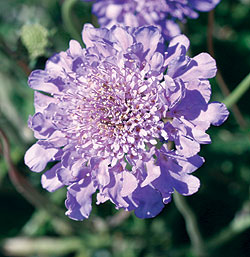 Fat, blue pincushion flowers that bloom and bloom
Scabiosa may be a standard for seasoned gardeners, but folks who are new to the joys of sun and soil may yet to have met this hardy garden performer. Scabiosa gets its common name, Pincushion Flower, because of the tiny, pin-headed stamens that appear to be stuck all over the center of the flower like pins in a cushion. The many petals begin as charming pillow-like curves, slowly opening into ruffled loveliness.
You will find Scabiosas in a host of blues, perriwinkle tones, and even pink. Plants may be either tightly or loosely mounded in growth habit. One of our favorites is the stunning, lilac-toned Blue Diamonds Pincushion Flower. It is a tidy, dense plant, and the color of those flowers simply pops in the garden. In point of fact, visiting a Scabiosa plant at sunset can prove an experience of optical delight - the petals seem to glow with a soft fluorescence.
Perhaps one of the very best things about this perennial is its extended blooming season. In mild climates, you can expect to be enjoying oodles of flowers from your Scabiosa from April - September. Pinching back spent blooms encourages new ones. When a Scabiosa is happy, expect hundreds of flowers from it each year. On the other hand, we do like to leave some seed heads, simply because of their fascinating spherical shape. They are hardy in zones 4-7.
Scabiosas make good companion plants
Because they are short (no more than 1 ft. in height, generally), using Scabiosas as an underplanting companion is a natural. Picture their soft blues at the feet of yellow roses, masking those less-than-lovely woody bases. Their rounded form is wonderful when contrasted with spiky Penstemmon or airy Yarrow.
Additionally, Scabiosas are a long lasting cut flower. Imagine what a pleasing mix you’ll be able to create with them and, perhaps, Buddleia, Pink Jasmine, or Coreopsis. This flower arranging article at Flowershop Network, features an incredibly lovely bouquet that you can take inspiration from when dreaming up ways to use Scabiosas to beautify your home.
Care and cultivation of Scabiosa in the garden
Scabiosas prefer full sun, but will tolerate a bit of shade, though the shadier the spot, the less flowers they will yield. Soil needs to be well drained, but they don’t appear to require exceptionally rich soils, unlike some perennial seeds, and we’ve seen them thriving in neglected areas. However, do give them a good start with some composted/fertized soil in the perennial bed, and be sure it is well drained. Water-logged soil is no good for these garden charmers. Neutral or slightly alkaline soil pH is preferable.
Springtime is actually the best time to trim back and prune Pincushion plants that have gotten weedy in growth habit. See where the new growth is coming in and trim back the old. If, after 3 or 4 years, you notice that the plant appears to have died back in the center, that’s the time to divide it into several smaller, healthy plants from around the edges and replant them.
In the end, some plants are finnicky, and gardeners put up with a lot of hassle to coax blooms from them. This is why it’s so nice to find a plant like Scabiosa that seems bent on bringing abundance to your garden with very little help from you!
If you have any tips on growing the very best Scabiosa, or have a gardening question, do let us know.
Thursday 23 Nov 2006 | Garden Pro | Gardening Advice
I need to know, how tall does scabiosa foliage get on the big perennial plants?